
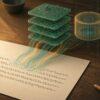
The idea in one picture: a loop in which each turn makes the next one faster.
A prominent AI commentator argues that machines have begun to accelerate their own development. Here is what the evidence shows, what it doesn’t, and why it matters beyond Silicon Valley.
For years, “recursive self-improvement” sounded like science fiction: an AI that helps build a better AI, which builds a better one still, each round arriving faster than the last. On November 13 the podcaster Dwarkesh Patel published a 44-minute video essay with a blunt title: “Recursive self-improvement has started.” What does he mean, and how solid is the ground beneath it?
What the idea means
At its simplest, recursive self-improvement is a feedback loop. Today, people write the code and run the experiments that make the next AI model smarter. If AI takes over a growing share of that work, the next model arrives sooner. If that model is better at the work, the one after it arrives sooner still. The excitement, and the worry, come from the compounding.
Patel says that earlier this year he would have put superintelligence “at least the better part of a decade” away. After three months of debate and watching progress, he now believes we are “only a couple of years away, and possibly only a couple of months away” from AIs as good as the best humans at AI research. His median guess for that milestone is 2028, assuming labs are not slowed by choice or by governments, and he gives at least a 25% chance that it does not happen until after 2032.
The evidence
The strongest evidence is not Patel’s own. METR, an independent AI evaluation organization, spent eleven weeks inside Anthropic, the maker of Claude, with unusual access to internal data. Its public report, published November 5, concludes that Anthropic is likely improving its models on well-specified tasks at around twice the rate it did between March 2024 and October 2025. The team’s best guess is that a majority of today’s acceleration, perhaps about 80%, comes from Anthropic’s extensive use of its own AI for research and development, mostly as an assistant to human staff rather than as an independent researcher. METR also says it did not find clear bottlenecks likely to halt further progress over the next twelve months.
Patel adds figures the companies published themselves: OpenAI’s heaviest 10% of internal AI users went from about $1,000 a day of coding-agent use at the start of summer to over $7,000 a day by late August, and Anthropic said Claude now leads 26% of its AI research work, up from under 1% in February.

His wider argument runs through mathematics. AI systems, he notes, could not reliably add four-digit numbers in 2023; this year they have begun solving long-standing open problems. AI research, which rewards trying many ideas and checking what works, looks to him like the problem-solving these systems already do well. Automated researchers, he argues, would be faster and far more numerous than people, though he expects steep diminishing returns and limits from computing power.
What the evidence does not show
METR’s finding is careful, and its caveats deserve as much attention as its headline. The true speed-up, the team says, could be closer to 1.3 times or 3 times. Its measurements focus on tasks that are easy to grade, so it is unclear whether messier real-world work has sped up as much. Anthropic’s earlier progress may have been unusually slow; when other companies’ models are included, the measured acceleration falls to about 1.4 times. Staff polls reporting very large personal speed-ups are, in METR’s words, “only very loose evidence.” And AI is not yet making highly significant, fully autonomous contributions to the most important parts of model training, although researchers described “signs of life.”
The biggest limitation is transparency. Anthropic had the right to redact non-public information, and METR says the company “redacted a majority of the evidence we found most informative” for its conclusions. As a result, METR writes, “the public has to rely on METR’s judgment much more than would be ideal.” Anthropic described the redactions as “aimed at removing confidential information that could accelerate other AI developers.”

The strongest objections
Patel engages several objections himself. Today’s AIs cannot learn on the job the way people do; each session starts fresh. That was his own main reason for skepticism last December, and it is why he keeps a real chance on a slower timeline. Others argue that the hardest part of research is taste, knowing which questions to ask, which is difficult to measure or train. The philosopher Toby Ord, whom Patel quotes, has written that while AI is starting to automate mathematical proof, “there is currently very little evidence that they can ask powerful questions or find profound new fields of mathematical enquiry.” Data and computing power for experiments are further limits. Patel argues these bottlenecks are real but not crippling. Even he calls the question of whether progress then explodes or settles into a shorter burst “basically a coin toss.”
METR measured something that has already happened at one company; Patel’s dates are personal estimates built on top of it.
Why it matters to the rest of us
If even the cautious version of this story is right, the pace of change in AI could speed up rather than hold steady. That matters for jobs, schools and businesses that plan on a few years’ notice. It matters for safety too: as an 80,000 Hours explainer points out, each faster cycle leaves less time to check that a new model is safe before it helps build the next one.
Anthropic itself is blunt. In the filing Anthropic made ahead of its planned stock-market listing, ABC News reports, the company warns that its products could pose “catastrophic or existential risks” and acknowledges that its safety measures cannot be guaranteed. According to 80,000 Hours, Anthropic’s latest filing also says it has crossed its own internal threshold of two years of AI progress in one.
None of this calls for panic. It does call for attention: for independent measurement that does not depend on a company’s permission, for clear public reporting, and for ordinary readers to follow a question that once seemed to belong to science fiction. The loop may not be running at full speed yet. But the best available evidence suggests it has begun to turn.
References
- Dwarkesh Patel, “Recursive self-improvement has started” (YouTube video, November 13, 2026) — https://www.youtube.com/watch?v=1NHPDzpfR6Y
- Dwarkesh Patel, “The avalanche that hit math is coming for AI development” (companion essay, November 13, 2026) — https://www.dwarkesh.com/p/rsi
- METR, “Independent Assessment of AI R&D Acceleration at Anthropic in October 2026” (November 5, 2026) — https://metr.org/blog/2026-11-05-anthropic-ai-rd-acceleration-assessment/
- 80,000 Hours, “The Scariest AI Report I’ve Ever Seen. Anthropic Redacted Parts of It.” (YouTube video, November 12, 2026) — https://www.youtube.com/watch?v=P6-_knLbuuk
- 80,000 Hours, “Is Anthropic on the cusp of RSI? Inside the redacted METR report” (episode page and transcript) — https://80k.info/METR-RSI
- ABC News, “Anthropic’s new warning” (YouTube video, October 27, 2026) — https://www.youtube.com/watch?v=M8j_Py_TQ9k
Images: original illustrations generated for this article.










Recent Comments