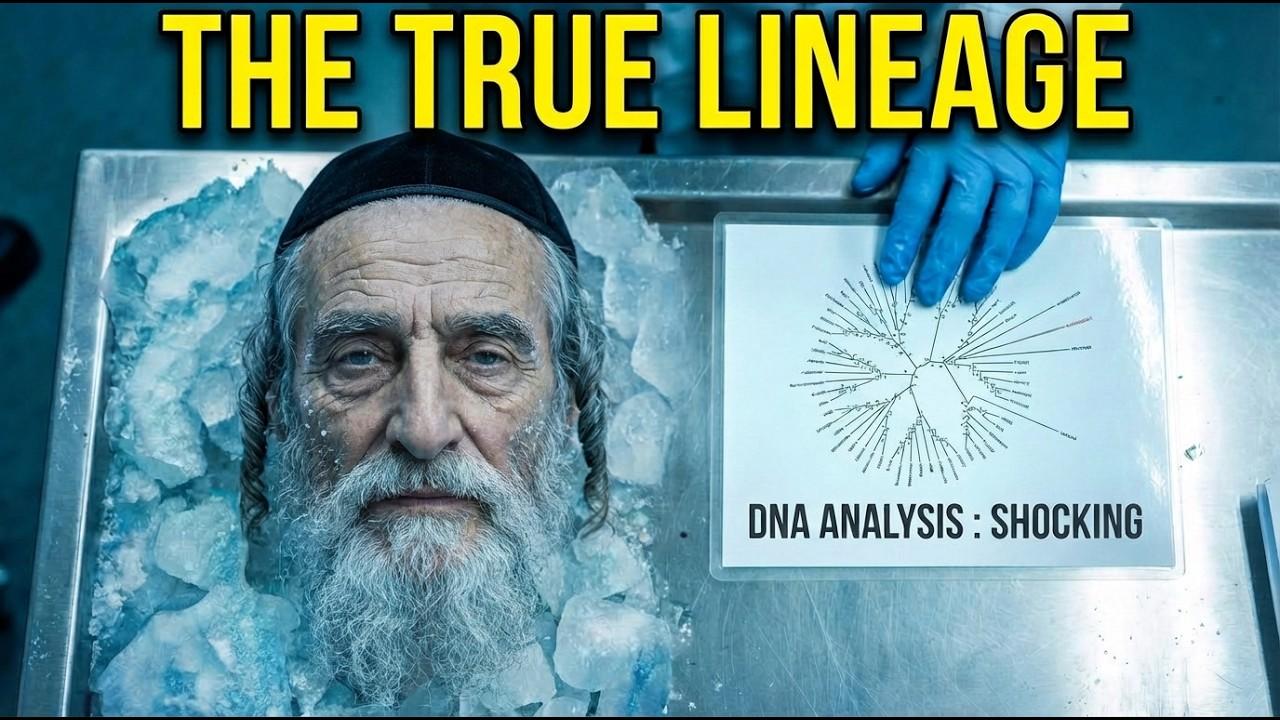
This video is interesting because it deals with something that seems almost impossible: after thousands of years of exile, migration, danger, rebuilding, and life among many different peoples, a Jewish genetic signal can still be seen. That does not mean Jewish identity is "just DNA." It is not. Jewish identity is religion, memory, law, family, food, prayer, argument, humor, books, holidays, and survival.
Still, DNA can tell us something real. It can show that Jewish history was not carried only in scrolls, prayers, and stories. Some of it was also carried in families and bodies. That makes the story both scientific and deeply human.
Why Scientists Were Surprised
For a long time, many people assumed that an old genetic signal would disappear after so much movement. Jewish communities lived across the Middle East, Europe, North Africa, Central Asia, India, Ethiopia, and later the Americas. They spoke different languages, ate different local foods, lived under different rulers, and adapted to very different places.
After all that, would any ancient ancestry still be visible? Many people expected the answer to be no. But newer DNA studies gave a more complicated answer. Yes, Jewish communities mixed with local populations. History is never sealed in glass. But no, the older signal did not disappear.
That is the key point. The diaspora changed Jewish communities, but it did not erase them.
Movement Without Disappearing
Diaspora means living scattered away from an original homeland. Jewish history is full of diaspora, but also full of return, rebuilding, memory, debate, and adaptation. When a smaller community lives among much larger populations, it can blend in completely over time, or it can keep strong boundaries around marriage, religion, custom, and family life.
Jewish communities often did the second. That does not mean there was no mixing. Of course there was. But many Jewish communities married mostly within the group for long periods of time. Over centuries, that helped preserve a shared ancestry signal.
In simple terms, the community moved, but it did not fully dissolve.
The Cohen Story
One of the most memorable parts of the video is the Cohen story. In Jewish tradition, Cohens are linked to the ancient priestly line, and that identity is passed through the father. Scientists looked at Y-chromosome DNA, which also passes from father to son, and found that many men with Cohen traditions shared related genetic markers more often than expected.
This does not prove every detail of an ancient story. DNA is not a time machine, and it should not be treated like one. But it does suggest something remarkable: a family tradition remembered for many generations may have left a biological trace. Suddenly, an old tradition is not only words in a book. It may also have an echo in living people.
The Bottleneck
Another striking idea is the Ashkenazi bottleneck. A bottleneck happens when a large future population descends from a small number of ancestors. Research suggests that the modern Ashkenazi Jewish population went through a small founding period in medieval Europe, possibly involving only a few hundred people.
That is hard to imagine. Millions of people today may descend from a relatively small group that lived centuries ago. This also helps explain why certain inherited diseases are more common among Ashkenazi Jews. If a rare gene variant existed in a small founder group, and that group later grew quickly, the variant could become more common too.
That is not only a history fact. It is also a medical fact, and it is one reason genetic screening can matter for some families. History leaves fingerprints. Sometimes they appear in documents. Sometimes they appear in health risks.
DNA Can Help, But It Can Also Mislead
This is where common sense matters. DNA is powerful, but it is not magic. It can show patterns of ancestry, shared roots, migration, and inherited disease risk. It can help scientists and doctors understand parts of the past.
But DNA cannot measure faith. It cannot measure courage, kindness, belonging, loyalty, humor, prayer, or memory. It cannot decide who has the right to join a people, love a tradition, or live a Jewish life. A convert does not need a DNA test to be Jewish. A person with Jewish ancestry may or may not live a Jewish life.
So the lesson is not that Jewish identity is genetic. That would be too small and too crude. The better lesson is that Jewish history is so strong that it left traces in both culture and DNA.
Change And Continuity
This story avoids two lazy ideas. The first lazy idea is that identity is only blood. It is not. Jewish identity is far bigger than genetics. The second lazy idea is that identity is only an idea with no connection to family history. That is also wrong. Jewish communities were real families in real places, making real choices across real centuries.
The truth is more human. Jewish communities changed. They moved, learned new languages, lived in different countries, and mixed with some neighbors. They also kept traditions, family patterns, religious memory, and a powerful sense of peoplehood.
Change and continuity happened at the same time. That is what makes the story so powerful.
Written In Books, Written In Bodies
Jewish history was written in books: Torah, prayers, commentaries, letters, songs, records, and arguments. But some of it was also written in bodies: migrations, family lines, founder groups, inherited risks, and shared ancestry.
Neither record tells the whole story alone. Books without bodies can become legend. DNA without memory can become just data. Together, they tell a deeper story. They show a people surviving not by staying frozen, but by carrying something forward through constant change.
The Big Lesson
The Jewish DNA story should not make anyone obsessed with purity. That would completely miss the point. The point is endurance. A people can mix and still remember. A people can move and still carry a thread. A people can suffer and still rebuild.
After 3,200 years of migrations, science looks closely and finds that the thread is still there. Not as a replacement for faith or culture. Not as the final definition of identity. But as one more sign that history is not as fragile as we sometimes think.
Source video: [Jewish DNA evident after 3200 years of migrations…](https://youtu.be/9-xP96LzFLU)







Recent Comments