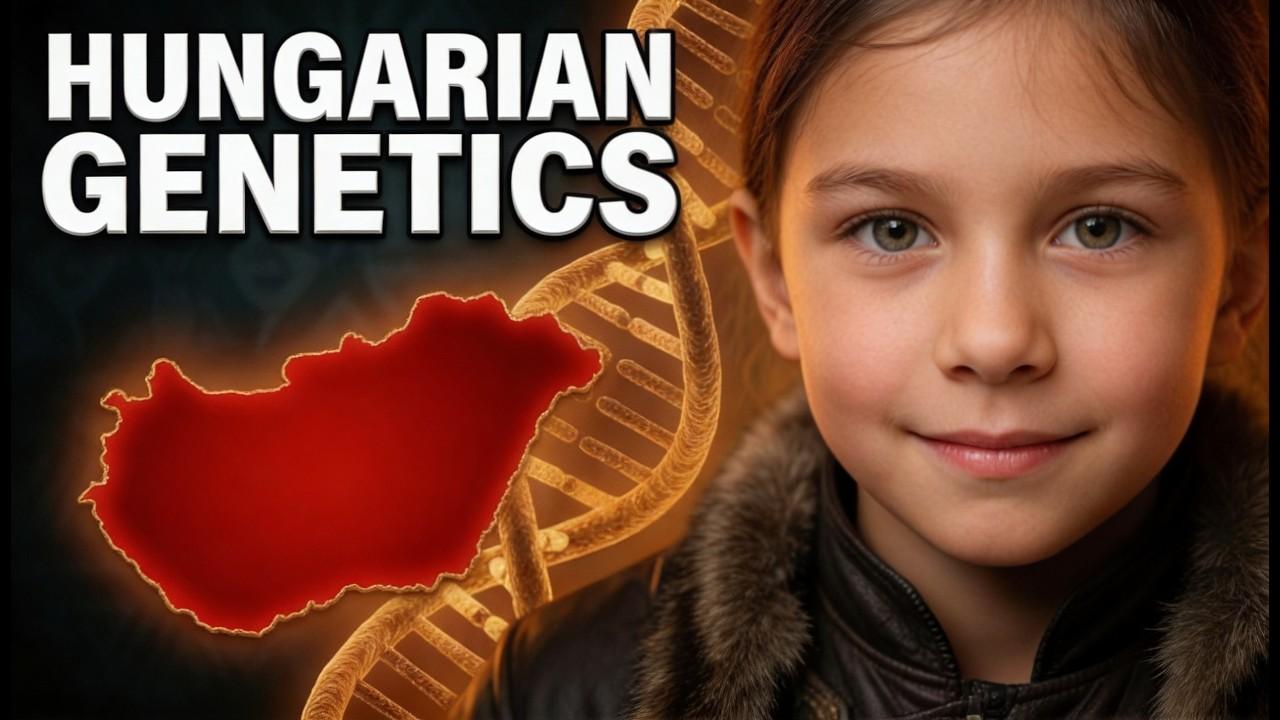
This video raises a strange and wonderful question: can a people keep a language even after most of the original DNA behind that language has faded away? Hungary gives us one of the clearest examples. Modern Hungarians are mostly Central European by ancestry, close to many of their neighbors. Yet the Hungarian language points somewhere very different, toward older peoples of the steppe and the forest zones far to the east.
At first, that sounds almost impossible. We often imagine language and DNA traveling together, like two suitcases carried by the same family. But history is rarely that tidy. People move, marry, conquer, trade, settle down, and blend into larger populations. Genes can mix very quickly. A language, however, can survive if it becomes useful, powerful, loved, or simply normal in daily life.
The Simple Story Was Too Simple
For a long time, the popular story sounded easy. The Magyars rode into the Carpathian Basin around the year 895. They came from the east, took control of the region, settled there, and became the ancestors of modern Hungarians. It is a neat story, but the DNA evidence makes it more interesting than that.
Ancient DNA from early Magyar graves does show an eastern signal, which makes sense. But that signal is much weaker in modern Hungarians. In plain English, the people who brought the Hungarian language were eventually absorbed into a much larger local population. They did not vanish in one dramatic event. They mixed, married, had children, and became part of the human landscape already living there.
That is the fascinating twist: the DNA changed, but the language stayed.
How A Smaller Group Can Change A Larger Population
Imagine a smaller group arriving with horses, weapons, leaders, and control over important routes. They may not be the majority, but they can still become the people who run the army, collect taxes, control trade, and decide what language matters in public life. Local families may learn that language because it helps them deal with power, improve their position, or simply get along.
After a few generations, children may grow up speaking the new language at home. Their grandparents may have spoken something else, and their great-grandparents almost certainly did. But children do not learn language from DNA. They learn it from parents, neighbors, teachers, priests, soldiers, markets, songs, and ordinary conversation. Once a language becomes the language of daily life, it can outlive the original group that brought it.
This may be close to what happened in Hungary. The Magyars may have been outnumbered, but their language won.
DNA Is Not Identity
This matters because people often talk about ancestry as if it explains everything. A DNA test can be useful and fascinating. It can show migration, mixing, and family history. It can tell us something real about where some ancestors may have come from.
But DNA cannot tell you what language your grandmother sang in. It cannot tell you what jokes your family told, what prayers they said, what recipes they guarded, or what stories shaped your childhood. DNA is passed through bodies. Culture is passed through memory, teaching, imitation, and love.
That difference is enormous. A baby does not inherit Hungarian, Polish, English, or Hebrew through genes. A baby learns a language because someone speaks to that child. Someone says "water," "come here," "be careful," "mother," "home," and "I love you." Words travel through breath before they ever appear in books.
A River Is A Good Picture
Think of a river. A smaller river flows into a bigger one, and after a while the water is mixed. You cannot separate it again. But the smaller river might still change the name of the whole river, or change its direction, or shape where towns grow along the banks.
That is a useful picture for Hungary. The Magyar newcomers blended into an older and larger population. Genetically, the larger local population mostly won. Culturally and linguistically, the Magyar language won. That is not a contradiction. It is exactly the kind of messy, human result history often produces.
Why This Is Food For Thought
The Hungarian case asks a bigger question: what makes a people? Is it blood, language, memory, land, religion, shared habits, old stories, or all of these at once? The answer changes from one people to another. Sometimes language and DNA travel together. Sometimes they split apart. Sometimes a group keeps an old language while mixing with many neighbors. Sometimes a group keeps ancestry but loses the old language.
Human identity is not a clean folder on a computer. It is more like an attic full of old photos, letters, tools, recipes, and forgotten objects that still somehow belong to the family. Messy, yes, but meaningful.
There is also a sad side to this story. Some small languages related to Hungarian are now endangered. When a language disappears, we do not only lose words. We lose jokes, songs, old memories, local knowledge, and a special way of arranging the world in the mind. DNA can be stored in a lab. A living language has to be spoken.
The Big Lesson
The Hungarian story is not only about Hungarians. It reminds all of us that culture can sometimes be stronger than blood. People move, mix, marry, forget, and remember. DNA tells one story, but language can tell another, and sometimes the language story is the one that lasts longer.
So the question is worth keeping: if the blood changes but the words remain, where does a people really live? Maybe the answer is simpler than we think. A people lives, at least partly, in the mouths of children who still know what to call the world.
Source video: [Language survives — DNA does not…](https://youtu.be/30_P0fCqAgs)







Recent Comments