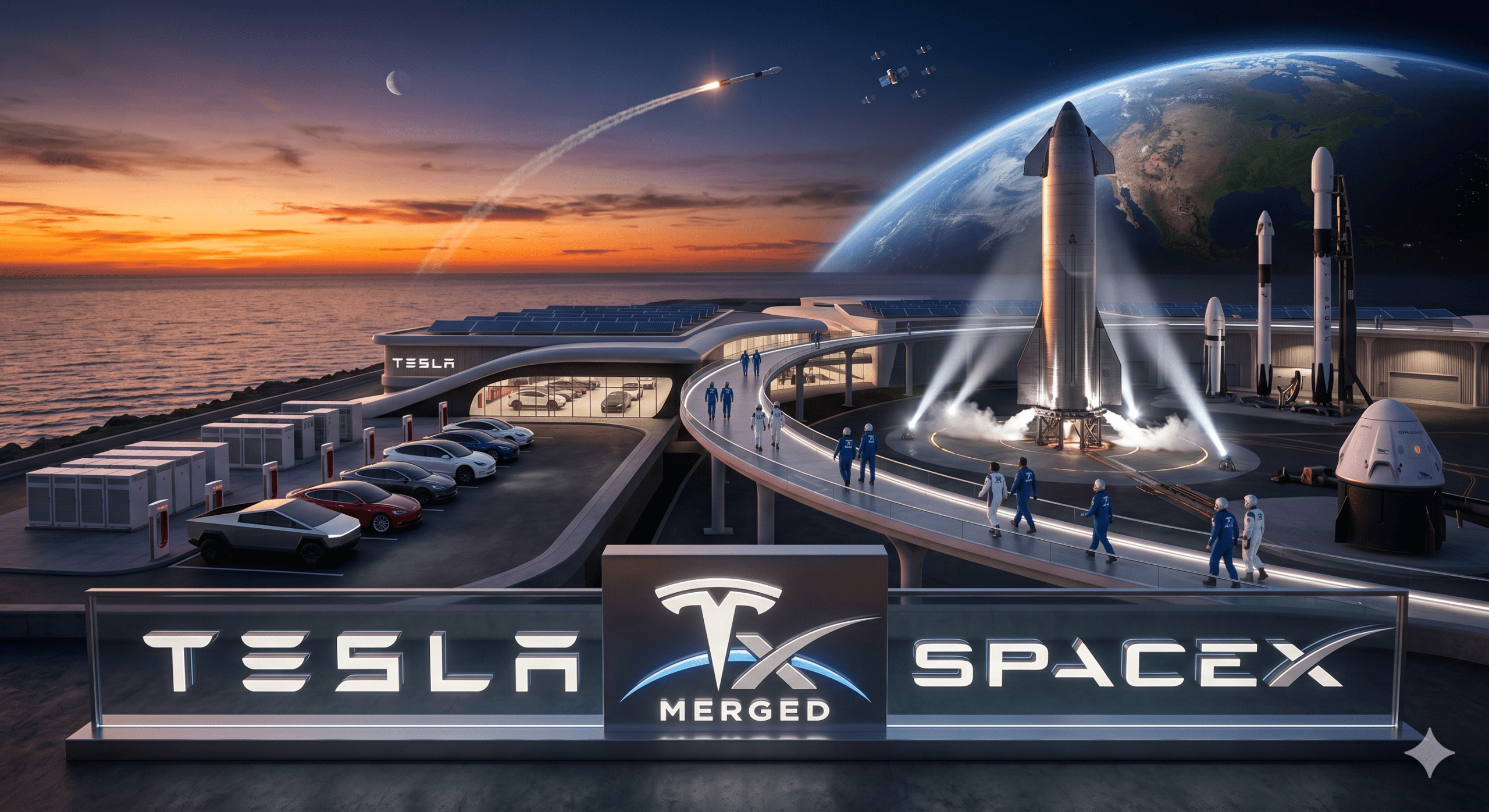
The idea of a merger between Tesla and SpaceX has circulated for years in investor circles, usually dismissed as an entertaining but improbable thought experiment. Tesla was viewed primarily as an electric vehicle manufacturer and energy company, while SpaceX occupied an entirely different universe of launch systems, satellites, and aerospace engineering. The businesses shared a founder in Elon Musk, but little else appeared to connect them structurally.
That perception has changed substantially in 2026.
The integration of xAI into SpaceX, forming the newly branded SpaceXAI organization, altered the strategic landscape in a way few analysts anticipated. Rather than operating as a separate artificial intelligence venture, xAI has now been folded into a much broader technological ecosystem that includes launch infrastructure, Starlink communications networks, AI computing systems, satellite operations, and the X platform. At the same time, SpaceXAI has announced plans for a public listing on Nasdaq under the ticker SPCX, with trading expected to begin on June 12. The move instantly transforms the conversation around a future merger with Tesla because it creates something that previously did not exist: a transparent public valuation for Musk’s space and AI empire.
As a result, investors are beginning to ask a more serious question. If Tesla increasingly defines itself as an AI and robotics company rather than simply a car manufacturer, and if SpaceXAI evolves into a vertically integrated communications and artificial intelligence platform with aerospace capabilities, are these still separate industries at all? Or are they gradually becoming pieces of a much larger technological system that Elon Musk may eventually want to consolidate?
Although a merger remains speculative, it is no longer difficult to understand the logic behind it.
Tesla today is fundamentally different from the company most investors encountered a decade ago. While automotive manufacturing still drives revenue, Musk consistently emphasizes that Tesla’s long-term value depends on artificial intelligence, autonomous transportation, robotics, energy infrastructure, and software. The company’s Optimus humanoid robot project, full self-driving ambitions, AI training systems, and custom computing hardware increasingly occupy center stage in Tesla’s strategic narrative. In many ways, Tesla now resembles an industrial AI company disguised as an automaker.
SpaceXAI is evolving along a similarly expansive trajectory. SpaceX was once understood mainly as a rocket company pursuing reusable launch technology and Mars colonization. That description is now incomplete. Through Starlink, the company operates one of the world’s fastest-growing satellite communication networks. Through xAI integration, it has become deeply involved in large-scale artificial intelligence infrastructure and data processing. Through X, it controls a globally influential digital communications platform capable of generating enormous real-time information flows useful for AI training and behavioral analysis.
The overlap between Tesla and SpaceXAI is therefore no longer philosophical alone. It is increasingly operational.
Both companies rely heavily on advanced AI models, custom chips, robotics, automation systems, distributed computing, materials science, and large-scale manufacturing. Tesla vehicles continuously generate real-world driving data that can be used for machine learning. SpaceXAI controls communications infrastructure capable of supporting autonomous systems globally through Starlink. Tesla develops robots intended to perform physical labor and navigation tasks, while SpaceX has extensive expertise in autonomous navigation, docking systems, and mission automation. Even their engineering cultures appear remarkably aligned, emphasizing vertical integration, aggressive iteration cycles, and software-driven hardware development.
For this reason, the possibility of a merger no longer sounds entirely futuristic. It now resembles a plausible strategic extension of trends already underway.
Still, plausibility should not be confused with probability. A merger between Tesla and SpaceXAI would be extraordinarily difficult to execute and would face major financial, regulatory, and governance challenges. Even with the recent changes surrounding SPCX, the likelihood of a full merger in the near term probably remains moderate rather than high. A realistic estimate may place the odds somewhere between 25 and 35 percent over the next decade, significantly higher than analysts might have predicted several years ago, but far from inevitable.
One major reason for caution is that SpaceXAI may not require Tesla in order to thrive. The upcoming SPCX IPO could become one of the most significant public offerings in modern market history. If investors assign valuations approaching the levels some analysts anticipate — potentially well above one trillion dollars — SpaceXAI may gain abundant independent access to capital. In that scenario, the strategic benefits of remaining separate could outweigh the advantages of consolidation.
Tesla shareholders may also hesitate to absorb the risks associated with aerospace and defense infrastructure. Many investors purchased Tesla shares because they wanted exposure to electric vehicles, energy storage, robotics, and AI software. A merger with SpaceXAI would suddenly expose them to launch economics, satellite infrastructure spending, national security contracts, geopolitical complications, and potentially massive long-term capital commitments tied to Mars exploration. The resulting company could become so broad that traditional valuation models would struggle to categorize it.
That concern should not be underestimated. Public markets generally prefer companies with understandable business models and measurable operating metrics. Conglomerates often trade at valuation discounts because investors find them difficult to analyze. A merged Tesla–SpaceXAI entity could become one of the most complex corporations ever listed publicly, spanning transportation, artificial intelligence, aerospace, communications, robotics, defense technology, and energy infrastructure simultaneously.
Yet the very complexity that worries some investors may represent the merger’s greatest attraction for others.
The strongest argument in favor of consolidation lies in the creation of an integrated AI-industrial ecosystem. Tesla’s future ambitions depend heavily on autonomous systems. Autonomous vehicles and robots require continuous connectivity, enormous computational resources, sophisticated machine learning models, and real-time global data processing. SpaceXAI increasingly controls all of those components. Through Starlink, it possesses global communications infrastructure. Through xAI, it is building advanced AI capabilities and training systems. Through X, it has access to a massive information ecosystem and behavioral data environment. Through SpaceX, it operates launch systems capable of deploying and maintaining satellite networks independently.
A combined company could therefore achieve forms of vertical integration unlike anything currently existing in the technology sector.
Tesla robotaxis connected globally through Starlink networks could operate even in remote regions where terrestrial communications infrastructure is weak. Tesla Optimus robots could leverage AI systems developed within SpaceXAI’s computing architecture. Autonomous logistics systems, energy management networks, robotics fleets, and communications infrastructure could potentially operate inside a unified ecosystem controlled by a single organization.
From a shareholder perspective, the appeal is obvious. Tesla investors would gain direct exposure not only to autonomous transportation and robotics, but also to the rapidly expanding commercial space economy. SpaceX already dominates launch services and satellite deployment markets, while Starlink is emerging as a major telecommunications platform in its own right. Government and defense contracts continue growing, and future applications involving orbital infrastructure, AI systems, and global communications may expand dramatically over the coming decades.
Such a merger could also strengthen the narrative premium surrounding Tesla shares. Investors often reward companies perceived as defining the future rather than simply participating in existing industries. A combined Tesla–SpaceXAI entity might be viewed less as a conventional corporation and more as foundational infrastructure for next-generation technological systems. In financial markets, narratives matter, and few narratives are more powerful than the idea of a unified platform spanning AI, robotics, communications, energy, transportation, and space.
Nevertheless, the risks would be equally enormous.
Space exploration remains intensely capital-intensive, even with SpaceX’s breakthroughs in reusable rockets. AI infrastructure is also becoming increasingly expensive as companies race to build massive compute clusters and data centers capable of supporting advanced models. A merged company could require staggering levels of ongoing investment, potentially pressuring margins and increasing financial volatility. Tesla shareholders accustomed to evaluating automotive deliveries and software revenue growth might suddenly confront highly unpredictable aerospace spending cycles.
Governance concerns would likely intensify as well. Elon Musk already exerts substantial influence across multiple major companies. Consolidating Tesla and SpaceXAI would centralize even greater economic and strategic power under one leadership structure. Critics would inevitably question whether the organization had become excessively dependent on Musk personally, particularly given the scale and complexity of the combined enterprise.
Regulatory scrutiny could also become severe. A corporation controlling autonomous transportation systems, satellite communications infrastructure, large-scale AI operations, robotics platforms, social media networks, and defense-related aerospace technology would attract extraordinary political attention around the world. Governments could view such concentration of technological power with increasing concern, especially amid rising geopolitical tensions surrounding AI and communications infrastructure.
If a merger eventually occurs, it is unlikely to happen abruptly. More plausibly, the companies would deepen operational cooperation gradually over several years. Tesla could integrate more closely with Starlink connectivity systems. Shared AI infrastructure projects could emerge. Robotics development might become increasingly collaborative. Investors would slowly grow accustomed to viewing the companies as interconnected components of a broader ecosystem before any formal merger proposal appeared.
The SPCX IPO itself may serve as the first major step in that process. Once SpaceXAI trades publicly, market participants will be able to evaluate the company through conventional financial mechanisms rather than speculative private valuations. That transparency alone makes future stock-based combinations considerably easier to structure.
Ultimately, the possibility of a Tesla–SpaceXAI merger reflects a broader shift occurring throughout the global economy. Traditional industry boundaries are dissolving. Vehicles are becoming software systems. Satellites are becoming communications utilities. Robots are evolving into labor platforms. Artificial intelligence is linking together industries that once operated independently.
Elon Musk appears to view these technologies not as separate sectors, but as interconnected layers of a single long-term infrastructure network. Whether or not a formal merger eventually happens, Tesla and SpaceXAI already appear to be moving toward increasing strategic convergence.
For Tesla shareholders, that convergence could prove extraordinarily valuable if executed successfully. It could also introduce levels of complexity and risk rarely seen in modern public markets. The eventual outcome will depend not only on financial considerations, but on whether Musk ultimately believes humanity’s technological future is best built through separate specialized companies or through one integrated system spanning Earth, orbit, artificial intelligence, and eventually, perhaps, far beyond.







Recent Comments