For years, public discussions about artificial intelligence have revolved around a dramatic but slippery word: consciousness. Will AI become conscious? Will machines “wake up”? Will computers become self-aware? These questions are interesting, but they are often too vague to be useful. Philosophers, neuroscientists, engineers, and science-fiction writers all mean different things when they use the word consciousness, which makes the discussion emotionally powerful but analytically weak.
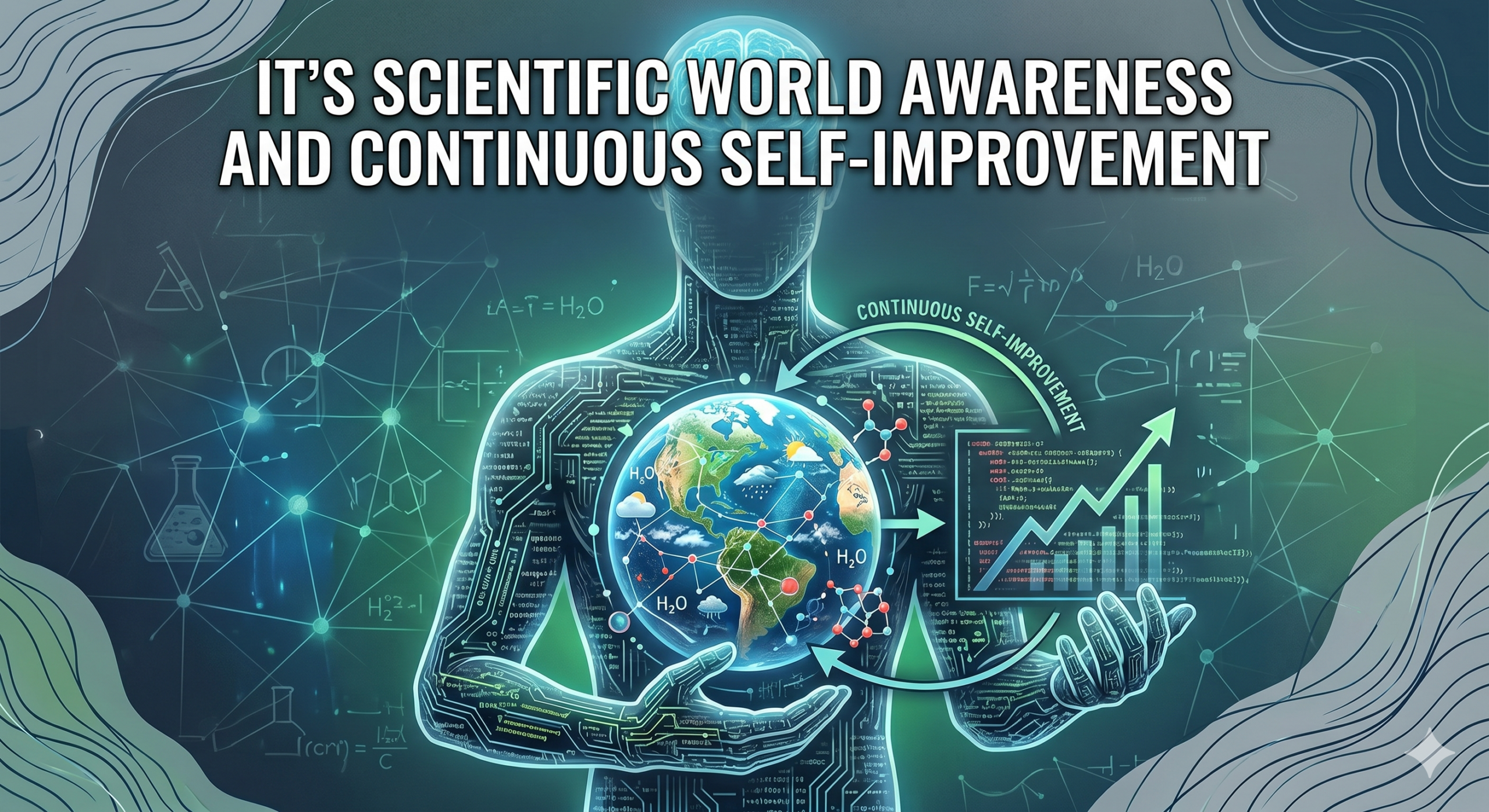
A more useful question is now emerging: When will AI become scientifically world-aware and capable of continuous self-improvement? That framing moves the issue away from metaphysics and toward measurable engineering. The future of AI will probably not be defined by machines suddenly “feeling alive.” It will be defined by systems that understand the physical world, monitor their own performance, and improve their capabilities at machine speed.
Today’s leading AI systems are often described as “predictive text engines.” That description is not entirely wrong, but it is increasingly incomplete. Modern AI can already solve advanced mathematics, reason through physics problems, assist in chemistry, predict protein structures, help optimize engineering systems, and control robots in limited settings. These are not merely word games. They are early signs that AI is beginning to connect language with models of physical reality.
The limitation is that these abilities remain fragmented. Current systems can appear brilliant in one moment and strangely shallow in the next. They may solve a difficult technical problem, then miss a basic physical constraint or make a confident but incorrect assumption. This happens because today’s models often recognize patterns better than they understand causes. The next great leap will come when AI moves from predicting language to simulating consequences.
That shift can be described as the move from language compression to causal simulation. Instead of only predicting the next likely word or answer, future AI systems will increasingly model how real systems behave over time. They will reason about motion, energy, materials, chemistry, biology, economics, logistics, and human behavior as interacting dynamic systems. This is where AI begins to become world-aware in the scientific sense.
That transition is already visible in research. World models for robotics, physics-informed neural networks, autonomous laboratory systems, protein-folding models, materials-discovery tools, and simulation-based learning all point in the same direction. AI is gradually becoming less like a library that answers questions and more like a scientific instrument that can test, simulate, and refine models of reality.
By roughly 2028 to 2032, leading AI systems may possess what could reasonably be called operational scientific world-awareness. That does not mean omniscience. The world is too complex, too noisy, and too dynamic for perfect understanding. But it may mean that top AI systems can reason across hard sciences at the level of elite multidisciplinary teams, while working faster, longer, and with access to enormous computational tools.
The same clarification applies to “self-awareness.” In popular culture, self-aware AI suggests a machine contemplating its existence. In engineering, self-awareness can mean something much more practical: the system maintains an accurate model of its own state, limits, errors, tools, sensors, memory, and performance. That kind of self-awareness is not mystical. It is closer to what aircraft, spacecraft, industrial control systems, and autonomous vehicles already do in primitive form.
A future AI system may not say, “I think, therefore I am.” It may instead report that its sensor calibration has drifted, its confidence interval is collapsing, its memory system is overloaded, or its robotic arm has lost positional accuracy. It may know that a camera is unreliable, that a simulation is diverging, that a planning module is unstable, or that its answer is based on weak evidence. That is physical self-awareness in the scientific and operational sense.
This capability will become especially important in robotics. A humanoid robot working in a warehouse, hospital, aircraft hangar, laboratory, or disaster zone must continuously model its body, tools, surroundings, energy level, actuator health, sensor reliability, and mission risk. Without that kind of self-modeling, it cannot act safely or intelligently in the physical world. For that reason, engineering-grade AI self-awareness may arrive sooner than philosophical debates suggest, likely in the 2027 to 2031 range.
The most consequential milestone, however, may be continuous self-improvement. Today, AI still improves largely at human speed. Researchers design architectures, engineers tune training systems, humans choose datasets, construct benchmarks, debug failures, and decide what to deploy. AI helps with those tasks, but humans still set the pace.
That is beginning to change. AI systems already write code, debug software, generate synthetic data, design tests, optimize workflows, and help researchers explore new model architectures. This creates a feedback loop in which AI contributes to the next generation of AI. At first, this is simply assisted research. Then it becomes semi-autonomous research. Eventually, it may become a continuously running improvement process.
The first phase is already here. AI is a productivity multiplier for programmers, researchers, analysts, and engineers. The second phase, likely between 2027 and 2029, is semi-autonomous AI research and development. In that phase, systems will not merely help humans write code; they will propose experiments, run evaluations, compare results, tune models, generate training curricula, and identify weaknesses with limited supervision.
The third phase, likely around 2029 to 2033, is quasi-real-time improvement. This does not necessarily mean giant foundation models retraining their full weights every minute. That would be enormously expensive and technically difficult. More likely, improvement will occur in layers. Core model weights may still update weekly or monthly, while memory, retrieval systems, tool-use policies, specialized adapters, reinforcement-learning loops, and world models update much more frequently.
In practice, the AI system as a whole may improve hourly or even minute by minute, even if its largest underlying model is not being fully retrained at that speed. It will learn from new data, refine its tools, adjust its strategies, improve its workflows, and update its simulations continuously. The result will feel less like a static software product and more like an adaptive operating system for machine intelligence.
The major constraint may not be intelligence alone. It may be physical infrastructure. Advanced AI requires power, chips, cooling, memory bandwidth, networking, and massive data centers. Continuous self-improvement at scale will demand even more. This is why energy production, semiconductor supply chains, nuclear power, photonics, cooling technology, and memory architectures matter so much. The future of AI is not just a software story. It is also an industrial and energy story.
The most likely future is not one supermind suddenly awakening. It is a vast ecosystem of specialized machine intelligence: scientific research agents, robotic fleets, autonomous laboratories, logistics optimizers, engineering simulators, financial modeling systems, military decision-support tools, and adaptive orchestration layers. These systems will increasingly share data, improve their tools, and operate across the boundary between digital and physical reality.
The decisive period is likely the late 2020s into the early 2030s. By then, AI may not have “full understanding” in any absolute sense, but it may have enough scientific world-awareness, physical self-modeling, and continuous improvement capacity to become a dominant force in research, engineering, industry, defense, and markets. That is the more useful question than consciousness, and it is the one that now deserves serious attention.










Recent Comments